Showing posts with label color. Show all posts

Tuesday, October 24, 2017

Can horses change color?

Sometimes, yes - and sometimes quite dramatically. Gray horses slowly become white as they age. Appaloosas are notorious for being quite different looking as youngsters than as adults. Some horses change color dramatically with the seasons - I know an appaloosa who's entire winter undercoat is white.

Horses can also get vitiligo (which causes white patches over time).


Friday, June 30, 2017

What eye colors can horses have?

Most horses have brown eyes. If lack of skin pigmentation includes the eye, then the eye can be wholly or partly blue (parti-colored eyes are also seen in some species of dogs). This can also lead to heterochromia (one brown eye, one blue).

Blue eyes are also seen on double dilutes. Single dilutes - buckskins and palominos - often still have brown eyes, but they are lighter in color.

The champagne gene turns the eye blue-green at birth and hazel or amber at maturity. Paso Fino horses also carry a gene that produces an amber eye.

Green eyes are extremely rare in horses. They are found in horses that carry the pearl gene (a rare dilute gene) and very, very rarely on homozygous cream or cream and champagne - but in all these instances the eye is more commonly blue, amber, or hazel.


Normal brown eye (source AnemoneProjectors via Wikimedia Commons).


Blue eye on a paint horse (Source: Kalike via Wikimedia Commons).


And a hazel eye. The mottled skin is another clue that this horse is a champagne. (Source AnemoneProjectors via Wikimedia Commons).

Wednesday, June 21, 2017

What is a "Jerusalem donkey?"

Most donkeys (except for some breeds, such as the Mammoth Jack, which have had it bred out) have a cross on their backs.

It's a pretty legend that the cross was given to the donkey because he carried Christ to Jerusalem - hence the term "Jerusalem donkey."


The "arm" of the cross is clearly visible on the grey donkey in the foreground. Although the black one likely still has the marking, it is not visible against its much darker coat.

Tuesday, February 7, 2017

Why do Akhal-Tekes have shiny coats?

Going to talk about a specific breed - because what's going on with them is really cool.


This is an Akhal-Teke stallion named Ikon (image source Ulruppelt via Wikimeida Commons) and as you can see he is really shiny.

But how does he look like he was spun out of metal like that? Palominos are normally shiny, but this guy takes shiny one step further. The reason is that this breed has weird hair.

The opaque core of the hair is narrower or even absent, allowing the light to shine through the hair - except it refracts it a little to give that shimmery golden look. Black Akhal-Tekes can look blue or even purple.

It is very rarely seen in other breeds, and appears to be caused by a recessive gene. It occasionally shows up in Thoroughbreds, Warmbloods, Arabians and Quarter Horses - and probably indicates some distant steppe ancestry. (And of course in the occasional horse of mixed/uncertain breeding).

Wednesday, January 11, 2017

Why do horses have face and leg markings?

Horses often have white on their faces and lower legs - but why?

One thing we do know is that they are genetically extremely complex and the extent of them is influenced by uterine environment - we know this because clones have markings in the same location as their genetic parent but not to the same extent. The genetics are complex, involving multiple genes and often affected by base coat color (which is why you see larger white markings on "red" or chestnut horses).

Why do they even exist, though?

White markings definitely confer no advantage in the wild and may be a disadvantage. Przewalski's horses have no white markings.

So, the obvious explanation is, well, humans. We like white markings...or not. They come in and out of fashion and are considered highly desirable in some breeds and utterly undesirable in others. For example, in Friesian horses and Dales cobs anything more than a tiny white mark on the forehead is considered grounds for not registering the animal. Meanwhile, Arabian breeders often like a lot of "chrome." Four whites are liked by some, but there's an old British saying of "One buy him, two try him, three suspect him, four reject him" that talks about white leg markings.

One reason why humans might have started to breed for white markings in the first place is that they do make animals easier to tell apart.


This chestnut Quarter Horse has a stripe on his face and a white sock on his off hind - quite smart!

But the wide variety of face and leg markings in horses reflects a pattern of human preferences that varies from place to place and across time.

Thursday, November 24, 2016

Why do some horses change color in winter?

Some horses appear to be a quite different shade in winter to what they are in summer. Why? There are two different reasons:

1. Some darker haired horses bleach a fair bit in the sun. Then the winter coat comes through at their "normal" color and appears much darker. (It's the same phenomenon that gives some brunettes "highlights" towards the end of summer, self included).

2. Horses have an interesting coat cycle. All horses, although it's more pronounced on ponies and horses that are kept in cold climates, have a single-layer coat in summer and a double-layer coat in winter. On some individuals, either the outer guard hairs or the "fluffy" undercoat come through a different color. I used to know a horse who would go from brown to bright red when his winter coat came through, and the Appaloosa mare I ride has a nearly white undercoat which makes her look much lighter.

The second phenomenon is fairly rare, enough to be remarked on, but not so uncommon that people don't know about it.


Wednesday, September 28, 2016

What are Chubari spots?

Chubari spots are something seen on some grey horses - they're also called "Tetrarch spots" after a Thoroughbred stallion who is the ancestor of most grey Thoroughbreds. Because of this, they're most often seen in that breed.

They are large white spots that show up as the horse starts to grey and then, of course, disappear once the coat fades around them.


(I was unable to find a picture I could legally use on this blog - if anyone happens to have one I could use it would be absolutely awesome).

Monday, September 26, 2016

What is bloody shoulder?

Bloody shoulder sounds awful, but it's just an unusual pattern that forms on some grey horses.

The horses affected are what are called "fleabitten" grays - they keep tufts of their base color for a while as they lighten. Sometimes these tufts join together to form larger patches - most often on the horse's shoulder, hence the name. When found elsewhere they are called blood marks. They often look red or red-brown.

These markings are more common on Arabians simply because the fleabitten grey pattern is particularly common in the breed. The Bedouin consider blood marks a sign of quality, partly because they are pretty much impossible to breed for - you can breed for the flea bites, but blood marks are pretty rare.

Bloody shoulder markings can actually get bigger with age. Also, sometimes horses will go dappled and then develop flea bites, which can result in this:


The brown color of the blood mark, which is extensive, and the dark points tell me this horse is bay "under" the grey. Image source, Kumana via Wikimedia Commons.

Friday, September 23, 2016

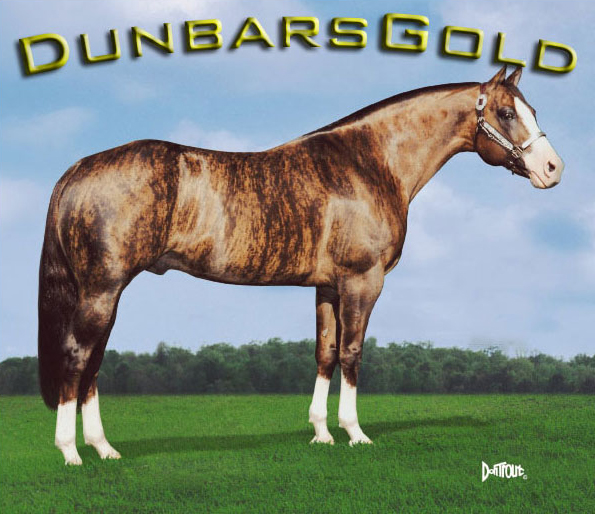
Are there brindle horses?

Maybe. Sort of.

No brindle gene has been found in horses and the coloration is vanishingly rare.

This is Dunbars Gold - and he sure looks like a brindle. Well, here's the rather interesting situation.

A breeder who owned a mare named Sharp One, also brindle, bred the mare to Dunbars Gold, with the intent (by the way, I am not typoing - the AQHA does not allow 's in registered names) of seeing if breeding a brindle to a brindle would give her a brindle foal.

Quarter Horses have to be DNA typed. When she sent in the sample, she was told that not only was Dunbars Gold not the sire of her foal but Sharp One was not the dam, and was told she had obviously sent in a sample from the wrong foal.

Snag is? She only had the one foal on the property. And Dunbars Gold's owner only had the one stallion. There was no way the sample could have been mixed.

So, they re-tested both the sire and the dam and when they did a blood type on Dunbars Gold they found he was a mare! No Y chromosome to be found. Obviously, this also could not be accurate, because he was siring healthy foals. So they went back to hair typing - and discovered that Dunbars Gold was, in fact, a chimera - twins that fused in the womb.

Aha. Lets test the mare now. And her other foals for good measure. They discovered that the foal they were testing was showing as unrelated to both the mare and his older sister. Explanation? Sharp One is also a chimera, and one of her ovaries is from one cell line and the other from the other...

So, are all brindle horses chimeras? Most are. In 2014 an inheritable form of brindle was discovered in a single family of horses, but it turned out to be a rather nasty disease that resulted in male fetuses being non-viable and the surviving females having abnormalities of the teeth, hooves and eyes, and it also causes areas of hairlessness. These brindles had Incontinentia Pigmenti (there's a similar condition in humans).

In other words? There are no true brindle horses, but if you want to put one in your story, go ahead. (And if you want a cool trait for a fantasy horse breed that doesn't really exist in the real world, how about an entire breed of brindles?)


Image source: Kersti Nebelsiek via Wikimedia Commons.

Thursday, February 25, 2016

Is a horse scared when you see the whites of his eyes?

Often. The way a horse's eye is structured, you don't normally see the whites at all - unlike human eyes. The only time the whites are visible is when the horse is scared or over-excited and their gaze is moving all over. If you look very closely you can see a little bit of white.

There are exceptions. If the horse has less pigmentation around the eye, then the white of the eye also becomes more visible. This is most common in Appaloosas and horses with similar coloring.


Friday, February 5, 2016

What are the points?

I realized I've used this term but I'm not sure I defined it properly.

The points of the horse are the mane, tail, lower legs and tips of the ears. They are sometimes a different color from the horse's body.


You can see here that both the red-brown (bay) horse and the mottled (bay roan) have black points.

Friday, November 14, 2014

What is a coronet?

The word "coronet" means two things when referring to horses:

1. The top of the hoof, specifically the area from which the hoof grows. Damage to the coronet, also called the coronet band can cause serious hoof problems and lameness.

3. A white marking that forms a thin ring around the top of the hoof.


A white coronet. Image source Kersti Nebelsiek via Wikimedia Commons.

Thursday, November 13, 2014

What are stockings?

If socks are white markings on a horse's legs that are fairly short, then obviously stockings are fairly high. Sometimes the term "high white" is used - in this case generally for white going all the way up the leg, which is often indicative of sabino (If white is also on the flanks and belly, then it is definitely one of the sabino variants).

Socks stop below the knee or hock. Stockings carry on above it.

Stockings are common on pinto horses that carry the tobiano, sabino or splashed white genes, but can also be seen on otherwise solid animals.


This Paint horse has stockings as well as everything else. (Based off of the ragged patch on his shoulder, this is a tovero horse).

Wednesday, November 12, 2014

What Are Socks?

No, horses generally don't wear socks under their shoes.

Socks are white markings that start at the hoof and extend to some point between the fetlock and the knee or hock.

A horse might have socks on one leg all the way to all four. Note that in some equestrian disciplines, horses with a sock on only one side are frowned upon because it can make their gait look uneven.


The chestnut horse in the center has a sock on his right hind leg. And is hamming it for the camera. Or asking me to take all that gear off his back, not sure which.

Tuesday, November 11, 2014

What Is A Bald Face?

"Bald" originally meant white, not devoid of hair. So a bald face is a completely white face, covering the entire front of the face and often also the lower lip.


Photo taken by Malcolm Morley. (If anyone has a better quality picture they'd be willing to let me use, let me know - I don't know any bald-faced horses).

Friday, November 7, 2014

What Is A Snip?

A snip is a white marking on a horse's nose, between the nostrils. The skin under it, like all white markings, is pink - this can often be particularly obvious on the nose, to the point where sometimes snips on grey horses are visible even after the horse has turned white.


This mare has both a star (discussed yesterday) and a snip - which is not uncommon. Her snip is wide and covers the nostrils.


Thursday, November 6, 2014

What Is A Star?

A star is a white spot on the horse's forehead. All horses have a whorl of hair in the center of their forehead, and sometimes a white marking forms around it. Stars are most often circular or close to circular, but can occasionally be closer to a diamond shape.


A rather "smudged" star on a black horse.


This bay also has a star. The white hairs around his muzzle are, like greying in humans, a sign of age.


A large, diamond shaped star on a Quarter Horse mare. (Often considered a very desirable marking.

Wednesday, November 5, 2014

What Is A Stripe?

A "blaze" is a broad stripe down a horse's face. A stripe is just a narrower one, that may be as thin as a pencil line.


Some people might call this stripe a blaze - it falls between the two, especially as the top reaches to the top of the eyes. I'm still tossing it up myself.


A much more distinct stripe on this Quarter Horse gelding, which narrows towards the top.

Ignore the delightfully spotted butt - you're looking at the chestnut, which has an extremely thin stripe.

Tuesday, November 4, 2014

What Is A Blaze?

No, I don't mean a stable fire.

A blaze is a broad white stripe down a horse's face. To be called a blaze, it has to reach at least the inside of the eyes and in some cases may cover the eyes. (If it does, the eyes are often blue).


This Quarter Horse mare has a blaze which runs all the way down to the lips. The lower lip also has some white on it. Note that the skin of the nose is pink.

Very wide blazes are sometimes associated with pinto genes, but as you can see this horse is otherwise solid.

Wednesday, October 29, 2014

Are Chestnut Horses Crazy?

Nope. Pure myth. I've met some crazy and "hot headed" chestnuts and also some calm ones, including a mare who let a beginner ride her the second time she was ever ridden. The best trail horse I've ever ridden was also chestnut, and her only temperament flaw was the exact opposite - she was just a bit lazy.

The only possibly supported link between temperament and color in horses is a possibility that pinto horses may be calmer than solid horses due to the link with domestication syndrome.

So, if you're going for a ride and they offer you a chestnut - don't worry. They're not crazy.

In her Paladin's Legacy series Elizabeth Moon assigns a similar superstition about gray or white horses to one of the cultures in her books. So, when worldbuilding, do think whether people in your world have ideas about specific horse colors. But be aware that if your horses are at all realistic, those ideas should be demonstrated to be very, very false.


I mentioned the mare who let a beginner ride her when she wasn't even trained? Here she is.